Custom Software Development Built Around How Your Business Actually Works
JITC designs and develops tailored business systems for Johannesburg organisations that need to replace manual processes, connect disconnected information, improve self-service or modernise software that no longer supports the way the business operates.
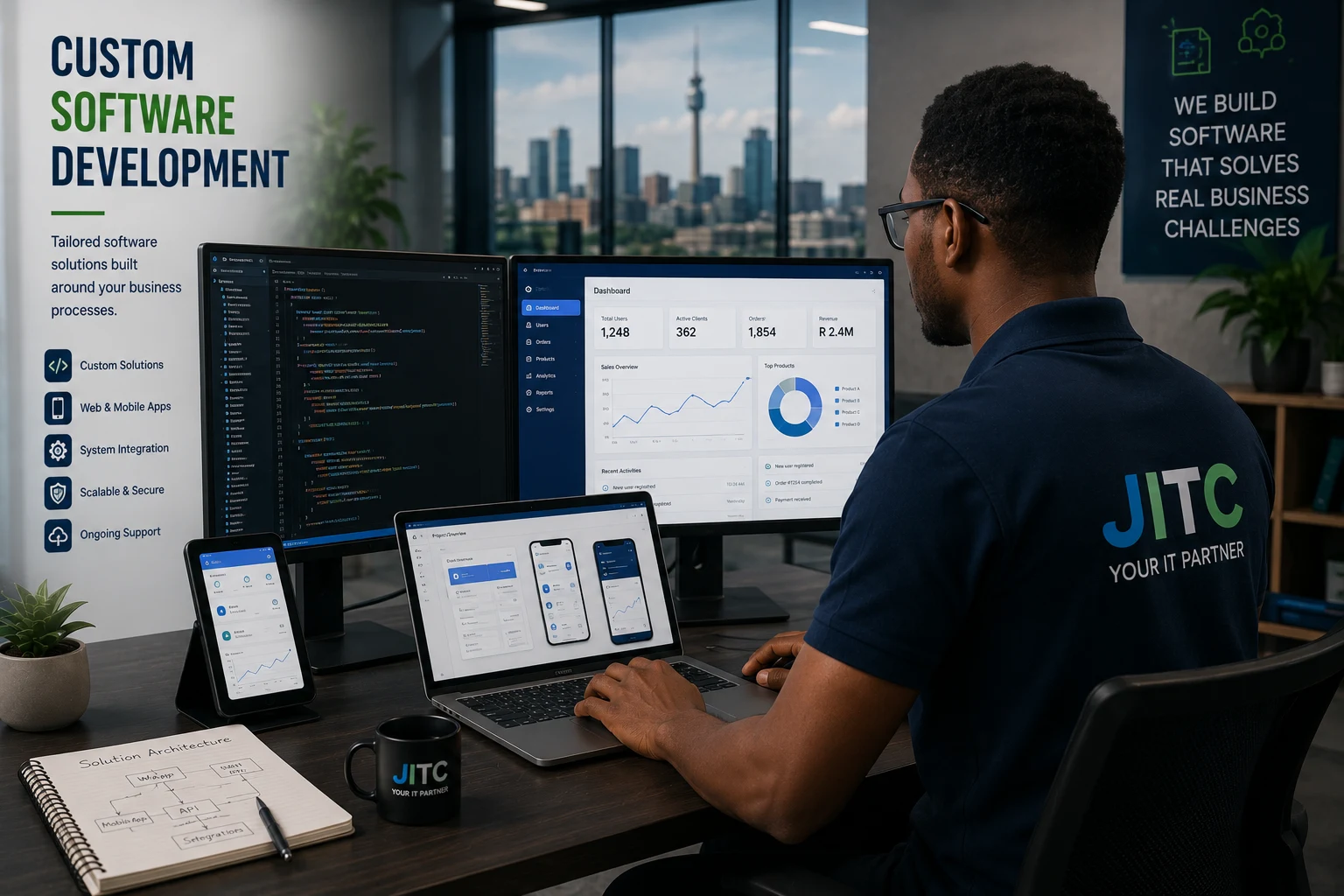
When teams spend their day working around software, the process itself becomes expensive.
Spreadsheets, duplicate capture, manual approvals, disconnected applications and email-based processes can work for a while. As the organisation grows, those workarounds create delays, errors and poor visibility.
JITC starts by understanding the operational problem. If an existing product can solve it well, we should say so. Custom development becomes valuable when the business needs workflows, integrations, data structures or user experiences that standard software cannot support economically enough.
Business software that connects workflows, users and information
The technology depends on the project. The consistent starting point is a clear business process, defined users and a practical outcome the software is expected to improve.
Workflow & Operations Systems
Replace repetitive manual processes, disconnected spreadsheets and informal approvals with structured workflows designed around how the business operates.
Customer, Member & Staff Portals
Give customers, members, suppliers or employees secure self-service access to the information, requests and processes relevant to them.
Dashboards & Business Reporting
Bring operational data together in practical dashboards and reports so teams can see status, trends, exceptions and performance more clearly.
System Integration & APIs
Connect existing applications where technical access allows, reducing duplicate capture and helping information move more reliably between systems.
Database & Data-Driven Applications
Replace fragile files and scattered records with structured applications that improve data quality, access control, search and operational visibility.
Legacy System Modernisation
Improve older business systems through targeted redevelopment, interface improvements, security work or staged replacement instead of assuming everything must be rebuilt at once.
Custom software is worth exploring when the cost of workarounds keeps increasing.
The decision should be based on business value—not on wanting something custom for its own sake. We compare the current pain, available standard products and the likely long-term value before recommending a build.
Critical processes depend on spreadsheets, email threads, paper forms or repeated manual data capture.
Your team enters the same information into multiple systems because the applications do not communicate with each other.
An existing business system is difficult to use, maintain, secure or extend as the organisation grows.
Customers, members, suppliers or staff need a secure self-service portal instead of relying on calls and email for routine requests.
Management lacks timely operational reporting because information is fragmented across files, systems or departments.
Available off-the-shelf products do not fit the business process well enough without excessive workarounds or ongoing inefficiency.
The goal is operational improvement—not software for software’s sake
A successful custom system should reduce friction, improve visibility and make important business processes easier to manage consistently.
Less repetitive work
Automate or structure routine tasks so staff spend less time copying information, chasing approvals and correcting avoidable errors.
Better operational visibility
Create clearer status, ownership and reporting so managers can understand what is happening without manually assembling information.
More consistent processes
Guide users through defined workflows, permissions and business rules instead of relying on memory or informal workarounds.
A system that can evolve
Design the solution around current priorities while leaving room for carefully planned integrations, modules and enhancements over time.
Software pricing should follow the process, users, data and integrations involved.
Custom Software Development is a project/custom-quote service. We define the important workflows and technical dependencies before estimating the build, rather than forcing different businesses into a generic software package.
Business processes & rules
The number of workflows, approval stages, exceptions and business rules determines how much analysis and development the solution requires.
Users, roles & permissions
Internal users, customers, administrators, branches and other user types may need different access levels, screens and responsibilities.
Data & migration
Existing spreadsheets, databases and legacy systems may require cleaning, mapping, import or migration before the new solution can become reliable.
Integrations & external systems
Accounting platforms, payment gateways, Microsoft 365, APIs, messaging services or other systems are scoped according to the access and interfaces available.
Security, audit & compliance needs
Authentication, permissions, audit trails, sensitive information and business-specific governance requirements influence architecture and testing.
Deployment, support & roadmap
Hosting, monitoring, backups, training, documentation, maintenance and future enhancements are considered as part of the software lifecycle—not afterthoughts at launch.
Discovery comes before development.
The JITC Way keeps the project connected to the business problem from discovery through delivery and long-term support.
Understand
We learn how the business works today, who uses the process, where time is lost, what information matters and what outcome the software must improve.
Assess
We review current tools, spreadsheets, systems, data, integrations, constraints and whether an existing product could solve the problem more economically.
Recommend
We define the proposed workflows, users, core modules, technical approach, priorities and project scope before committing to development.
Deliver
We build and review the agreed solution in controlled stages, test the important workflows and prepare the system for practical business use.
Support
After launch, JITC can provide maintenance, monitoring, documentation, user support and planned enhancements as the business and software evolve.
Start with the business problem you need the software to solve
Every build is scoped individually, but most custom software projects begin in one of these three areas.
Internal Business System
For organisations that need to digitise operational workflows, replace spreadsheets or improve how teams capture, approve and report information.
- Workflow and requirements discovery
- Role-based business application
- Dashboards and operational reporting
- Deployment and user handover
Customer, Member or Supplier Portal
For businesses that want customers, members, suppliers or partners to complete routine actions securely without relying on email and phone follow-up.
- Secure account and permission model
- Self-service requests and information
- Notifications and workflow routing
- Integration with internal processes
Integration & System Modernisation
For organisations that already have systems but need them to exchange information, remove repetitive capture or replace fragile legacy components in stages.
- Current-system assessment
- API and integration planning
- Legacy improvement or staged replacement
- Migration and continuity planning
Start with the wider Business Automation problem.
Some processes can be improved with existing tools, Microsoft 365, workflow automation or AI without building a new application. Business Automation helps identify the right level of solution before you commit to custom development.
Software works best when the workflow reflects the organisation using it
A member organisation, accounting firm, consulting business and construction company may all need automation, but the users, approvals, information and operational risks are very different.
Custom software depends on the wider technology environment around it
AI, cloud services, security and managed IT may all play a role depending on where the application runs, who uses it and what information it handles.
Not every operational problem needs custom development.
The free Business Technology Estimator can help identify whether support, cloud, security, digital growth or automation should be the first technology conversation.
Questions businesses ask before starting a custom software project
The right answer depends on the process, users, data, integrations and long-term value of solving the problem properly.
How do we know if custom software is justified?
JITC starts by understanding the business problem and comparing the cost of current inefficiency with suitable off-the-shelf products. Custom development is recommended when the required workflow, integration, data or user experience cannot be met economically enough by an existing product.
How much does custom software development cost?
There is no responsible single price for bespoke software because scope depends on workflows, users, permissions, data, integrations, security requirements and deployment needs. JITC defines the important requirements first and then prepares a project quotation around the agreed scope.
How long does a custom software project take?
Timing depends on the size and complexity of the agreed scope. A focused internal workflow can be very different from a multi-role portal with integrations and data migration. JITC defines milestones and delivery expectations after discovery rather than promising a generic timeline before the requirements are understood.
Can custom software integrate with our existing systems?
Often yes, provided the existing systems offer suitable APIs, exports, database access or other supported integration methods. Integration feasibility is assessed during discovery because third-party access, limits and licensing can affect the final approach.
Can you modernise an existing business system instead of replacing it?
Yes. Where practical, JITC can assess whether targeted improvements, interface changes, security work, integrations or staged replacement would create better value than rebuilding the entire system immediately.
Who owns the custom software after development?
Ownership, source-code access, third-party components, licensing and hosting arrangements should be stated clearly in the project agreement. JITC discusses these commercial and technical responsibilities before development so expectations are understood by both parties.
Do you support and maintain custom software after launch?
Yes. Ongoing support can include issue resolution, monitoring, backups, security maintenance, documentation and planned enhancements. The exact maintenance arrangement is agreed according to the system and the level of support the business requires.
Can custom software grow with our business?
Yes, when growth is considered during architecture and roadmap planning. JITC aims to build around clear modules, data structures and business priorities so future enhancements can be planned deliberately rather than added as uncontrolled complexity.
Define the requirement before the project is quoted.
Project services start with discovery and scoping. JITC clarifies the business objective, users, dependencies and deliverables before preparing a quotation or phased implementation plan.
Request project scoping in the Customer Portal New customers can start here without an account. Existing JITC customers can sign in and continue with the same service.Discover
Clarify the business problem, desired outcome and key constraints.
Scope & Quote
Define deliverables, dependencies, phases and the commercial proposal.
Build & Deliver
Implement, test, launch and support the agreed solution.
Let’s understand the workflow before we quote the software.
Show us the process, bottleneck or system you are trying to improve. We’ll clarify the users, information, integrations and priorities, then recommend whether custom software is justified and what a sensible first scope should include.